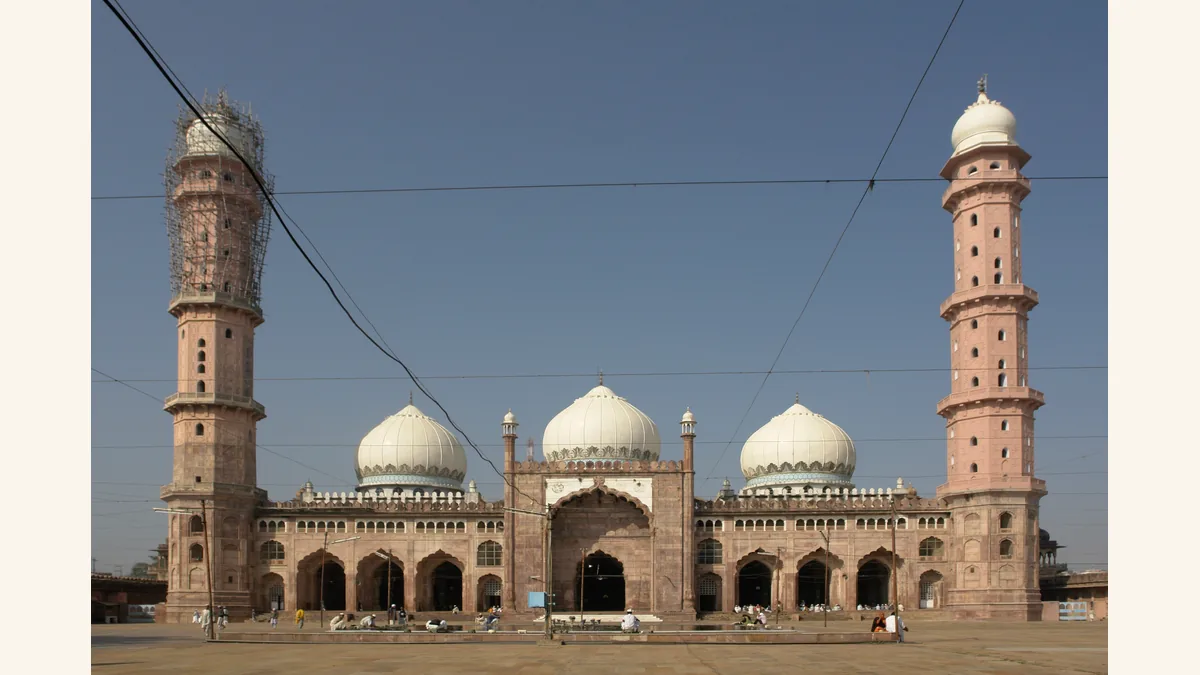
Hero photo Photo © Yann Forget / Wikimedia Commons · CC BY-SA 4.0 · cropped and resized
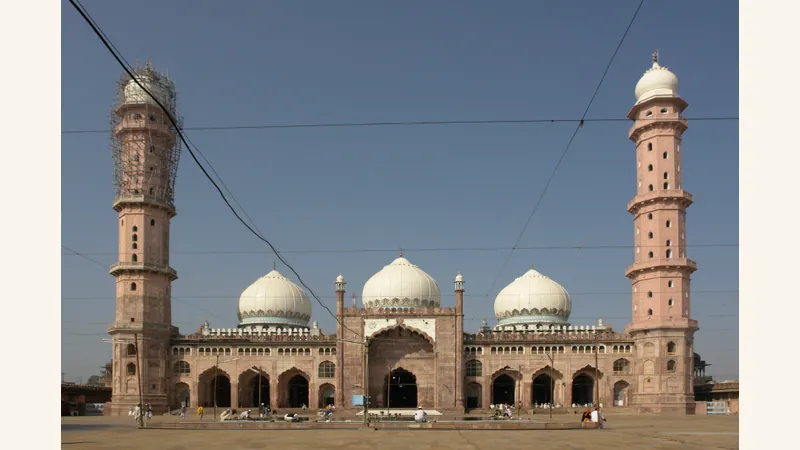
Taj ul Masajid Bhopal is one of the largest mosques in India, with two minarets about 67 m (220 ft) tall, three marble domes and room for around 26,000 worshippers. It is about 4 km from Bhopal railway station and about 9 km from the airport. The old city around it holds the Jama Masjid, Moti Masjid, Shaukat Mahal, Sadar Manzil and Gohar Mahal, all within a walk of about 4–5 km.
Non-Muslim visitors are welcome at Taj-ul-Masajid outside prayer times, and the mosque is kept for worshippers only on the weekly congregational day. Go early in the morning in winter, dress modestly, and keep half a day for the whole walk.
This is a heritage walk, not a festival post. It works in any season, but the cool months from late October to February are the best time to walk Bhopal's old city. Check mosque timings before you go. We confirm them for you when we send your plan.
Who were the Begums of Bhopal?
For about a hundred years, from the early nineteenth century to the early twentieth century, Bhopal was ruled by four women in a row: Qudsia Begum, Sikandar Begum, Shah Jahan Begum and Sultan Jahan Begum. Almost every landmark in the old city dates from their time.
Qudsia Begum, also called Gohar Begum, built Gohar Mahal by the Upper Lake, and the Jama Masjid in Chowk was begun in her reign. Sikandar Begum ordered the Moti Masjid, and Shaukat Mahal belongs to her period. Shah Jahan Begum, the great builder of the family, started Taj-ul-Masajid and the Taj Mahal palace. Her daughter Sultan Jahan Begum carried the mosque work forward.
So this walk is really a walk through four generations of one family, and the buildings tell that story in stone. You can read more on the Incredible India page for Bhopal. For the wider Islamic heritage of the state, see our guide to Islamic monuments across Madhya Pradesh.
What makes Taj ul Masajid Bhopal special?
The name means "Crown among Mosques". Shah Jahan Begum began the mosque in the nineteenth century, but money ran out after her death. Work stopped for decades and was finished only in the late twentieth century, led by the scholar Imran Khan Nadwi. The whole project took close to a hundred years.
The result is huge. The complex has a vast prayer hall and an expansive courtyard. Two pink minarets rise about 67 m, each topped with a marble dome. Three large white domes sit over the hall, and the courtyard has a big ablution tank in the centre. Inside, massive pillars hold up 27 ceilings, and the mihrab wall is finely carved.
From a balcony on the north side you look out on Motia Talab, a small lake, and across it on the Taj Mahal palace that Shah Jahan Begum built as her home. A madrasa, the Darul Uloom, runs inside the complex, and you will see students moving between classes.
For many years the mosque hosted Bhopal's famous three-day Ijtema, the Tablighi Jamaat gathering, before it moved out of the city for want of space. Read our Bhopal Ijtema visitor guide if your trip falls around that time.
Can non-Muslims visit Taj-ul-Masajid, and what are the hours?
Yes. Visitors of all faiths are welcome outside prayer times. Local guides list the mosque as open from about 6 AM to 8 PM, but it closes to visitors during the five daily prayers, and on the weekly congregational day it is kept for worshippers only. Entry is free. Please confirm the current timings when you plan, as they can change.
| Mosque | Built by | Visitor hours (approx.) | Distance from Bhopal station (approx.) | Note |
|---|---|---|---|---|
| Taj-ul-Masajid | Shah Jahan Begum, finished later | About 6 AM–8 PM, closed during prayers | About 4 km | Worshippers only on the congregational day |
| Jama Masjid, Chowk | Begun in Qudsia Begum's reign | About 6:30 AM–7 PM | About 2–3 km | Market all around; busy in the evening |
| Moti Masjid | Sikandar Begum | Daytime, outside prayers | About 2–3 km | Marble hall; near Iqbal Maidan |
| Dhai Seedhi ki Masjid | Dost Mohammad Khan's time | Daytime | About 3 km | Tiny mosque on an old fort bastion |
Hours from Incredible India and local guides. Check before you go, and never enter during prayers.
Etiquette that matters:
- Cover shoulders and knees. Women should carry a scarf for the head.
- Remove shoes before the prayer hall. Carry a bag for them or use the shoe stand.
- Keep your voice low and do not walk in front of anyone praying.
- Ask before photographing people, and never photograph worshippers at prayer.
- Do not bring food or drink inside.
Which other mosques should you see in old Bhopal?
Jama Masjid, Chowk. Begun during Qudsia Begum's reign and finished under her minister, this red-stone mosque took more than two decades to build. Its two minarets carry gold spikes, and three marble domes sit over the hall. The old market of Chowk wraps around it, with shops selling caps, prayer mats, zardozi work and the famous Bhopali batua purses.
Moti Masjid. Sikandar Begum's "Pearl Mosque" sits near Iqbal Maidan. It is built of red sandstone with a white marble prayer hall, and locals call it a smaller copy of Delhi's Jama Masjid. Two dark red minarets with gold cupolas frame the facade. This is the quietest of the three big mosques.
Dhai Seedhi ki Masjid. Up on a bastion of the old Fatehgarh fort stands a mosque so small it is often called the smallest in the world. Dost Mohammad Khan, the founder of Bhopal, built it in the eighteenth century so his guards could pray on duty. The name means "mosque of two and a half steps", after the little stair that once led to it. It sits inside a medical college campus today, so ask at the gate before you walk in.
What are Shaukat Mahal, Sadar Manzil and Gohar Mahal?
Three palaces stand around Iqbal Maidan, the open ground named after the poet Allama Iqbal.
Shaukat Mahal is the odd one out. It mixes Indo-Islamic lines with European Gothic and post-Renaissance details, and local tradition says a Frenchman of Bourbon descent designed it. Look for the tall windows, floral carving and the pale colour that sets it apart from the red mosques nearby.
Sadar Manzil, next door, was the hall of public audience of the Nawabs. Its brick-red front and garden have been restored, and it is now used for official events. You see it from outside unless an exhibition is on.
Gohar Mahal stands a short walk behind, right on the bank of the Upper Lake. Qudsia Begum built it in the early nineteenth century, blending Hindu and Mughal styles in a three-storey palace. MP Tourism runs its restoration, and the courtyards host craft fairs and exhibitions through the winter. The lake view from the back is the best photo spot on this walk.
How do you plan the half-day heritage walk?
MP Tourism's own Bhopal heritage walk starts at Moti Masjid and ends at Gohar Mahal. We add Chowk and Taj-ul-Masajid to it. Allow 4 to 5 hours with stops, and start by 7:30 AM in winter.
Tips for the route:
- Do Taj-ul-Masajid last, before noon, so you are out before the midday prayer.
- Chowk is best between 9 and 11 AM, when shops open but the lanes are not yet crowded.
- Stop for sulaimani chai and bun-maska in Chowk, or for Bhopali poha-jalebi near Iqbal Maidan.
- Finish with lunch in the old city, or ride to the Upper Lake promenade for the view.
How to reach old Bhopal and where to stay?
Bhopal is on the main Delhi–Mumbai and Delhi–Chennai rail lines, with fast trains from both sides. The old city is about 2–4 km from Bhopal Junction and about 9 km from Raja Bhoj Airport, so autos and cabs reach it in 15 to 30 minutes.
Stay near Hamidia Road or Shyamla Hills if you want to walk to the old city, or near the Upper Lake for a calmer evening. Our 1 night Bhopal package starts from ₹4,750 per person and covers the old city with a car and driver. The 2 night Bhopal package starts from ₹7,700 per person and adds Sanchi or Bhimbetka.
Have more days? The 2 night Pachmarhi package from Bhopal takes you from the old city to the hills in one trip. See all Bhopal tour packages and our list of top places to visit in Bhopal for the lakes, museums and Van Vihar.
Heritage walk checklist
- Check mosque timings and avoid the five prayer times.
- Skip Taj-ul-Masajid on the congregational day, or see it only from outside.
- Wear modest clothes and easy shoes. Carry a scarf and a bag for footwear.
- Start by 7:30 AM in winter and carry water.
- Keep small cash for autos, chai and the Chowk shops.
- Ask before photographing people; never photograph prayers.
- Ask at the medical college gate before visiting Dhai Seedhi ki Masjid.
- Pair the walk with Mandu's Afghan monuments for a two-city heritage trip.
Can we plan your Bhopal heritage trip?
We run Bhopal trips through the winter. We can arrange a car and driver for the old city, a hotel near the lake, and a local guide for the walk if you want one. We can add Sanchi, Bhimbetka, Mandu or Pachmarhi to the same trip.
Plan your old Bhopal heritage walk
Tell us your city, travel window and group size. We reply with a plan, the current mosque timings and the current price.
Send us your Bhopal trip request