GWALIOR · HILL FORT
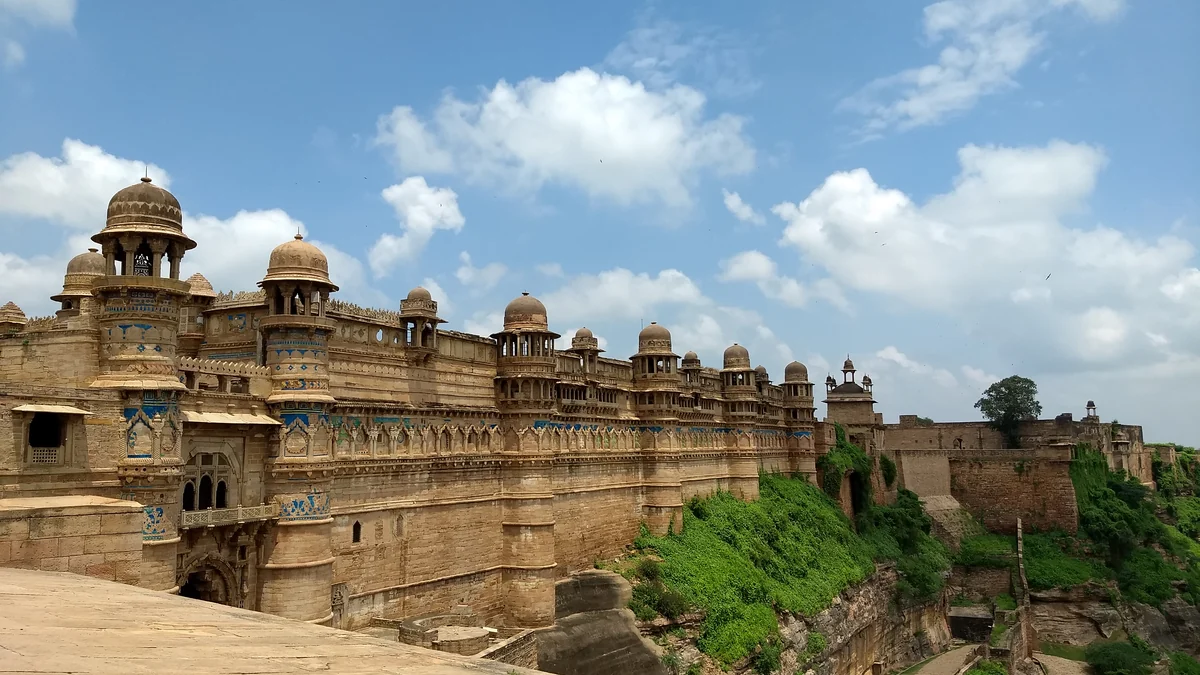
Gwalior Fort stands on a sandstone hill about 100 metres above the city. Keep 3 to 4 hours for it. The fort grounds are free to enter, one small ASI ticket covers Man Mandir Palace, the Sas Bahu Temples and Teli Ka Mandir, and the light and sound show in the evening costs ₹250.
Hero Photo: Ramakrishna Kongalla · CC BY-SA 4.0 · cropped, resized and converted to WebP.
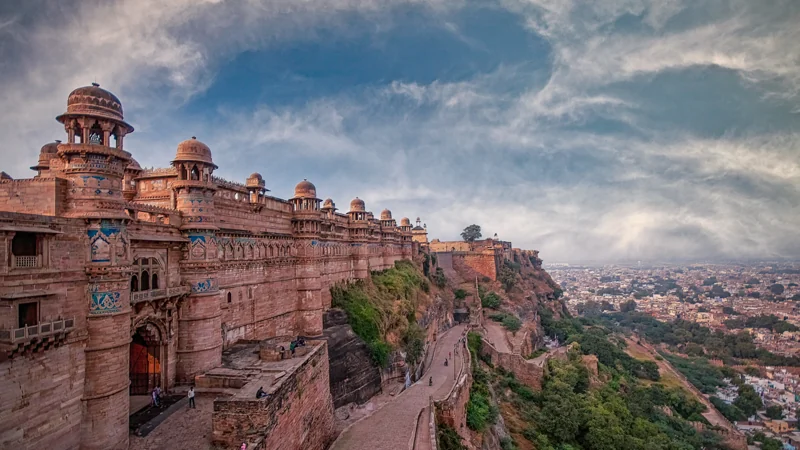
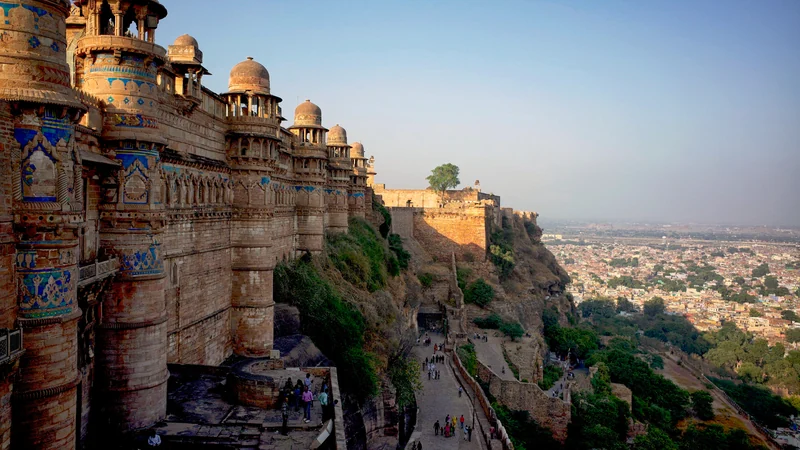
The Mughal emperor Babur called this fort the pearl among the fortresses of Hind, and you understand why the moment you see the blue and yellow tiles of Man Mandir Palace on the cliff. Inside the walls are palaces, temples more than a thousand years old, giant Jain statues cut into the rock and a famous gurdwara. This guide tells you what to see, what it costs and how to plan your time. For the rest of the city, read our guide to the places to visit in Gwalior.
What is the history of Gwalior Fort?
Nobody knows exactly who first built on this hill. A local legend says a chief named Suraj Sen was cured by a saint called Gwalipa and named the place after him. What we do know from stone inscriptions is that the hill has been in use for at least 1,500 years, and that almost every dynasty of north India fought for it.
| When | What happened |
|---|---|
| 6th century | An inscription records a Sun temple on the hill in the time of the Huna king Mihirakula. |
| 8th–9th century | The Gurjara-Pratiharas build Teli Ka Mandir. The small Chaturbhuj Temple (876 CE) carries one of the oldest written zeros in the world. |
| 1093 | The Kachchhapaghata king Mahipala completes the Sas Bahu Temples. |
| 1486–1516 | Raja Man Singh Tomar builds Man Mandir Palace, and Gujari Mahal for his queen Mrignayani. |
| 16th–17th century | The Mughals take the fort and use it as a state prison. Guru Hargobind, the sixth Sikh Guru, is held here. |
| 1858 | Rani Lakshmibai of Jhansi dies fighting the British near Gwalior. |
| Later | The fort returns to the Scindia rulers of Gwalior. |
So the fort is not one building from one period. It is a whole hilltop of monuments, and each one belongs to a different chapter.
What should you see inside Gwalior Fort?
The hilltop is about 3 km long, so do not try to walk to everything. These are the eight stops that matter, in the order most visitors see them.
| Place | Why go | Time |
|---|---|---|
| Man Mandir Palace | The face of the fort. Blue, yellow and green tiles with ducks, elephants and banana trees, and two floors of rooms below ground that later became Mughal prison cells. | 45–60 min |
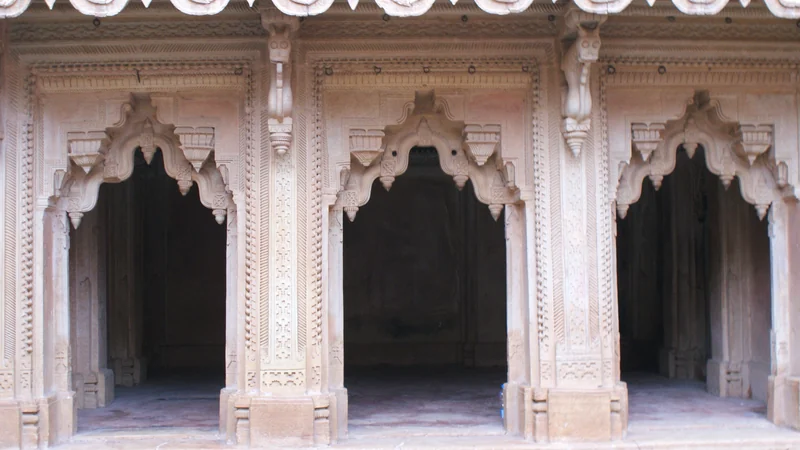
| Sas Bahu Temples | Two Vishnu temples of 1093 with carving on every pillar. The name comes from Sahastrabahu, the thousand-armed Vishnu. Great view of the city from the platform. | 30 min |
| Teli Ka Mandir | The tallest building in the fort, close to 30 metres high. Its roof is shaped like a south Indian temple and its walls like a north Indian one. | 20–30 min |
| Gurudwara Data Bandi Chhor | A white marble gurdwara that remembers Guru Hargobind's release from the fort along with 52 captive kings. Cover your head; langar is served. | 30 min |
| Jain rock-cut statues | Rows of Tirthankaras cut into the cliff on the Urvai road in the 15th century. The tallest standing figure is about 57 feet. | 15–20 min |
| Chaturbhuj Temple | A tiny rock-cut Vishnu temple on the eastern path, known for the zero in its 876 CE inscription. | 10 min |
| Gujari Mahal museum | The queen's palace at the foot of the hill, now an archaeological museum with sculptures from the 1st century onwards. | 30–45 min |
| Suraj Kund | The old tank linked to the Gwalipa legend. A quiet stop between the palace and the temples. | 10 min |
Short of time? See Man Mandir Palace, the Sas Bahu Temples and Teli Ka Mandir. All three are on the same ticket, and a car can take you from one to the next.
We have a separate guide for each of the three: Man Mandir Palace, the Sas Bahu Temples and Teli Ka Mandir.
What are Gwalior Fort timings and entry fees?
The fort is open every day. You do not pay to drive or walk up to the plateau, to see Man Mandir from outside, or to visit the gurdwara and the Jain statues. You pay only when you step inside the ticketed monuments.
| What | Timing | Fee |
|---|---|---|
| Fort plateau and viewpoints | About 6 am to 5:30 pm | Free |
| Man Mandir Palace, Sas Bahu Temples and Teli Ka Mandir (one ASI ticket) | About 8 am to 5:30 pm | Roughly ₹20–40 for Indian adults. Children below 15 free. Foreign visitors pay a higher rate. |
| Gujari Mahal museum | Day time, closed on Mondays | Small separate ticket |
| Light and sound show | Evening, see below | ₹250 adult, ₹100 child |
Buy the ASI ticket at the counter near Man Mandir Palace and keep it with you. The same ticket is checked again at the Sas Bahu Temples and at Teli Ka Mandir.
ASI changes its rates from time to time and gives a small discount for online tickets, so carry a little extra cash. A guide, the museum and the evening show are always paid separately.
What are the light and sound show timings at Gwalior Fort?
MP Tourism runs the show every evening in the open-air theatre at Man Mandir Palace. In about 35 minutes it tells the story of the fort, from Gwalipa to the Scindias, with the palace walls lit up behind.
| Season | Hindi show | English show |
|---|---|---|
| October to February | 6:30–7:05 pm | 7:20–7:55 pm |
| March to September | 7:30–8:05 pm | 8:20–8:55 pm |
Tickets cost ₹250 for an Indian adult and ₹100 for a child. Foreign visitors pay ₹700, and ₹350 for a child. See MP Tourism's show page for any change.
The monuments close before the show starts, so you cannot do both in one go. The easy way is to see the fort in the morning, rest at your hotel in the afternoon and come back up for the show. Winter evenings on the hill are cold, so carry a jacket.
How do you reach Gwalior Fort and plan your route?
The fort has two ways up, and the one you choose decides how much you walk.
Urvai Gate (west side)
The road for cars and taxis. You drive past the giant Jain statues and park on top, close to Man Mandir Palace. Choose this with elders and children.
Gwalior Gate (east side)
The old walking path. It starts near Gujari Mahal, climbs through a line of gateways, passes Chaturbhuj Temple and ends at Hathi Pol below Man Mandir. Steep, but the best views.
A good morning plan by car: drive up through Urvai Gate and stop for the Jain statues, see Man Mandir Palace first while it is cool, then the Sas Bahu Temples and the gurdwara, and finish at Teli Ka Mandir. Visit Gujari Mahal museum at the foot of the hill on your way down or the next day.
Gwalior railway station and the airport both have taxis and autos to the fort. Gwalior is on the main Delhi to Bhopal railway line, about 120 km from Agra, so many guests add it to an Agra or Orchha trip.
What is the best time to visit Gwalior Fort?
October to March is the best season. Days are pleasant, the sky is clear and the evening show starts early. From April to June the rock gets very hot by 11 am, so start at opening time and finish before noon. In the monsoon the hill turns green, but the stone steps are slippery.
- Start with Man Mandir Palace in the morning, before the tour groups arrive.
- Wear shoes with good grip. The palace has narrow, dark stairs to the lower floors.
- Carry water and a cap. There is little shade between the monuments.
- Carry a scarf or cap to cover your head at the gurdwara.
- Hire only a government-approved guide at the ticket counter and fix the fee first.
- Keep your car for the whole visit. The monuments are far apart.
With children, make it a game: find the yellow ducks on the palace wall, count the pillars at Sas Bahu and spot the tallest statue on the Urvai road. They will remember the fort far better than a list of dates.
Which Gwalior tour packages include the fort?
Every one of our Gwalior tour packages includes Gwalior Fort with an AC car that stays with you on the hill, plus Jai Vilas Palace and Tansen's Tomb in the city. Pick the plan that fits your days.
1 night in Gwalior
Our 1 night Gwalior package covers the fort and the main city sights with hotel, breakfast and station pick-up.
From ₹5,900 per person.
Gwalior with Orchha
The Gwalior and Orchha package adds the riverside palaces and temples of Orchha, about 125 km away.
From ₹9,400 per person.
Want to see the evening show too? Tell us while booking and we plan the return drive for you.
Plan your Gwalior Fort trip with us
Tell us your dates, your group size and where you arrive. Our team sends you a free day-wise Gwalior plan with hotel options and a clear price.